biggerz casino free spins sit at the centre of a question that is easy to ask and harder to answer, namely whether a spin benefit described on biggerz2027.com can be treated as something a reader can claim today. This publication has not verified current availability of any spin promotion, and the account below explains what the site's own materials do and do not establish. It is an information article rather than an invitation to sign up.
Contents
What the biggerz casino free spins listing actually records
The first thing to settle is what a spin listing on this site is. The site presents itself as an information publication covering casino games and cricket betting for an adult audience, with supporting resources on games, offers, mobile access, payments and account topics. A listing of spins therefore belongs to that reference material. It is a record of how a benefit has been described, not a live confirmation that the benefit exists at the moment a reader encounters it.
That distinction matters because the supplied brand description is careful about scope. It supports broad product categories and a qualified welcome-offer record, and nothing more. The description does not certify that a spin package is open, funded or accepting claims. When a page mentions spins alongside games and offers, the mention tells you the topic exists in the site's coverage. It does not tell you the terms behind it, the eligibility rules, or whether an operator is still honouring it.
A reader can test this by looking at what documents exist. A brand description is a summary. An offer record is a historical note. Neither is a set of current terms. The site itself says claims about current products or transactions need the relevant current terms, which places the burden on a live terms document rather than on any article. That is why a spin listing should be read as background, and why the absence of a linked current terms page leaves the availability question open rather than answered.
The publication also warns that a new article date does not establish that a product or offer is currently available. A recent date can make a page feel fresh without telling you anything about the status of the benefit it discusses. For spins, this is the central trap. A page updated this month may describe a package that closed last year. Freshness of writing and freshness of an offer are different facts, and only one of them is visible on the page.
Finally, the site states that availability, payment methods and promotions are subject to current eligibility and terms. That sentence is the closest the materials come to a rule about spins, and it is a rule about conditions rather than about access. It tells you that eligibility and terms govern, not that a particular reader qualifies. Read together, these points support one conclusion: the listing is a description with a historical character, and current availability for this particular benefit is unverified.
How spin rights, bonus amounts and use conditions get separated
Spin benefits usually bundle three separate things, and the site's materials treat them as separate for good reason. The first is the right itself, meaning who may take part and under what eligibility rules. The second is the amount or scale of the benefit, meaning how many spins or what value they carry. The third is the conditions of use, meaning how the spins may be played and what happens to anything they produce. A page that mentions spins without separating these three has told you a topic, not a package.

A concrete case shows why the separation matters. Suppose a reader finds a note saying a welcome record included spins. The note establishes that spins appeared in a described offer. It does not establish the eligibility rule, the scale, or the use conditions, and the site explicitly declines to supply those. The brand description supports the qualified welcome-offer record, and the general rule and payment sources explain their named subjects only. Neither source establishes current inventory or processing performance, so neither can fill the gap.
The amount question deserves its own caution. Numerical examples on this site are labelled as fictional, which means any figure used to illustrate how a bonus might work is artwork for explanation, not a quotation of terms. A reader who treats an illustrative figure as the real scale of a spin benefit has mistaken an example for a document. The honest position is that the scale of any spin benefit is a term to be read in the applicable current terms, and this article cannot supply it.
Use conditions are where most disputes would arise in practice, because they determine what a spin is worth to the person holding it. The site's warning that promotions are subject to current eligibility and terms covers this ground without spelling out any particular condition. It follows that no condition should be assumed from an article. A reader who wants to know how spins may be used must find the terms that govern them, and must accept that this publication has not verified that those terms are open or current.
Put together, the three parts form a checklist rather than an answer. Right, amount and conditions are the questions a spin listing raises. The site answers none of them for a present-day reader, and it says so. The correct reading is that the listing identifies the subject and the categories involved, while the operative detail lives in terms this publication has not seen and cannot vouch for.
What the game cards and illustrations can and cannot prove
The site carries external game cards, and their handling is instructive for anyone tempted to read a spin page as evidence. Those cards preserve their source links and provider attribution, and the attribution stays with the reference. A card is a pointer to someone else's material, not a statement by this publication about a product. One card carries a virtual-chip and adult-audience scope that remains attached to its own reference. That attachment is the model: a borrowed description keeps its limits.

Illustrations follow the same logic. Generated illustrations on the site are artwork rather than operator screenshots or evidence of a tested account. A picture of a spinning interface, however polished, proves that an image was made. It does not prove that a reader can reach that interface, that spins are credited there, or that any account has been tested. Treating artwork as a screenshot is a category error, and it is the error most likely to turn a descriptive page into a misleading one.
The external references also matter because they show what the site does not claim. The materials state that general rule and payment sources explain their named subjects and do not establish licensing, current inventory, processing performance or a supplier relationship. A game card from an outside source sits in the same position. It illustrates a category of product. It does not create an affiliation between this publication and any operator, and it does not convert a historical listing into a live benefit.
For spins specifically, the practical consequence is that neither card nor illustration can carry the weight of a terms document. If a reader wants to know whether a spin benefit exists, the card cannot say. If a reader wants to know what the benefit includes, the illustration cannot say. Both can help a reader understand what kind of product is being discussed, which is a modest and legitimate role.
The site's own correction policy reinforces this. Readers are asked to identify the passage and the applicable source when asking about a factual correction. That request only makes sense if passages are tied to sources and sources have limits. A spin description tied to a historical listing is correctable by pointing to the listing. It is not upgraded into current fact by the presence of a game card or a generated image, and no reader should treat it as though it were.
A hypothetical reader finds a spin page that mentions a welcome benefit and a game card beside it. She assumes the card confirms the benefit. It does not. The card confirms only that an outside source described a game. Her conclusion fails because the two documents answer different questions, and nothing on the page ties the card to the spin terms.
Consider a second hypothetical case involving a reader who screenshots a generated illustration and sends it to support as proof that spins were promised. Support can only point back to the passage and its source. The image proves an image was made. It cannot establish entitlement, because entitlement lives in current terms, not in artwork. The consequence is a delay while the real document is located.
A documentary check works differently. Ask whether the page preserves a source link and provider attribution for the card, and whether the spin sentence sits beside that card or in a separate section. If the spin sentence appears under a heading about games generally, the card supports only the category. If the sentence sits inside a borrowed description, the limits of that description travel with it. This distinction decides whether the card supports anything about spins at all.
One exception deserves attention. A page might carry a card whose own reference includes an adult-audience or virtual-chip scope. That scope stays with the reference and does not transfer to the spin listing. A reader who treats the card's scope as a condition of the spin benefit has merged two documents that the site keeps apart. The correction is to separate them again and to ask which document actually governs the benefit.
The correction policy adds a final consequence. A reader who wants a spin statement corrected should name the passage and the source it rests on. A complaint that cites only an illustration gives an editor nothing to check. A complaint that cites the listing behind the sentence can be verified, and if the listing is historical, the page can be marked accordingly. That is the only route by which a card or picture turns into a correction rather than a misunderstanding.
Reading eligibility, account and payment statements without overreach
Eligibility is the point where a descriptive page most often gets misread. The site says its coverage is for adults only, and it repeats the adult requirement in its closing statements. That is a scope rule for the publication, not a confirmation that any particular adult qualifies for a spin benefit. Eligibility for a promotion depends on the current terms of that promotion, and the site places promotions under exactly that condition. An adult reader is within the audience, and that is all the adult statement establishes.

Account topics raise a parallel issue. The site covers account subjects as reference material, and it asks readers to keep passwords and payment codes out of a support query. That request is a security practice, and it also signals what kind of information the site handles. It handles descriptions and questions. It does not handle credentials, and a reader should never send them anywhere in connection with a spin enquiry. A spin benefit that required a password to be shared in a message would be a warning sign rather than a convenience.
Payment statements need the same restraint. The site's payment sources explain their named subjects, and the materials explicitly say those sources do not establish processing performance. So a page that discusses payments cannot be read as a promise about how quickly anything happens or whether a method works for a given reader. Payment methods, like promotions, are subject to current eligibility and terms. The honest summary is that payment coverage is explanatory and that transaction claims require the relevant current terms.
A worked situation, offered as hypothetical, shows how these pieces fit. Imagine a reader who sees a spin mention, assumes an adult audience means automatic eligibility, assumes a payment page means a working method, and assumes an account page means a tested process. Each assumption borrows authority the source does not have. The adult statement covers audience. The payment source covers its named subject. The account material covers its topic. None of them certifies a live benefit, and the reader's conclusion fails at the first step.
The corrective is to match each statement to its scope. Audience rules govern who the publication is for. Payment sources govern what they explain. Account guidance governs how to handle sensitive details. Promotion terms govern promotions, and the site says so directly. When a reader keeps those scopes separate, the spin question resolves into a clear position: the topic is covered, the benefit is not verified, and no eligibility or payment statement can be stretched to fill the gap.
Why current terms, not article dates, decide a spin claim
The site makes one claim that governs every other consideration here. Claims about current products or transactions need the relevant current terms. That sentence is a rule about evidence. It says the document that decides is the current terms document, not a brand description, not an offer record, not an illustration, and not an article. For spins, the rule means that any statement about a live benefit must trace back to terms that are current and applicable to the reader.
Article dates cannot substitute for that document. The site states plainly that a new article date does not establish that a product or offer is currently available. A page can be rewritten, expanded or reorganised without any change in the status of the benefit it discusses. Readers often use dates as a shortcut for status, and the shortcut fails here. The date tells you when words were arranged. It does not tell you whether a spin package is open, closed, altered or awaiting new terms.
The publication's own position is consistent with this. It describes itself as an information publication, and it says a supplied listing is historical and that current availability for this particular benefit is unverified. That is not evasion. It is an accurate statement of what the materials support. The brand description covers broad categories and a qualified welcome-offer record. The listing records a history. Neither is a live terms document, and the site does not pretend otherwise.
What would change the picture is a current terms document that a reader could examine directly, with its eligibility rules, its scale and its use conditions intact. This article does not supply one, and it should not be read as pointing to one. The correct use of the article is to understand what questions to ask and which sources can answer them. A reader armed with that understanding will not mistake a description for a promise, and will not treat an unverified listing as an open door.
The practical summary is short. The site covers spins as a topic. It supports a qualified welcome-offer record and broad product categories. It does not verify current availability, and it warns that dates prove nothing about status. Anyone weighing a spin benefit should look for the current terms that govern it and should treat everything else, including this article, as background. Gambling is for adults aged 18+ only. A random number generator (RNG) determines outcomes in RNG-based casino games. Wins are not guaranteed.
Independent support: Gambling Therapy.
Sources on this site: Editorial policy, Editorial contact, Promotions guide.
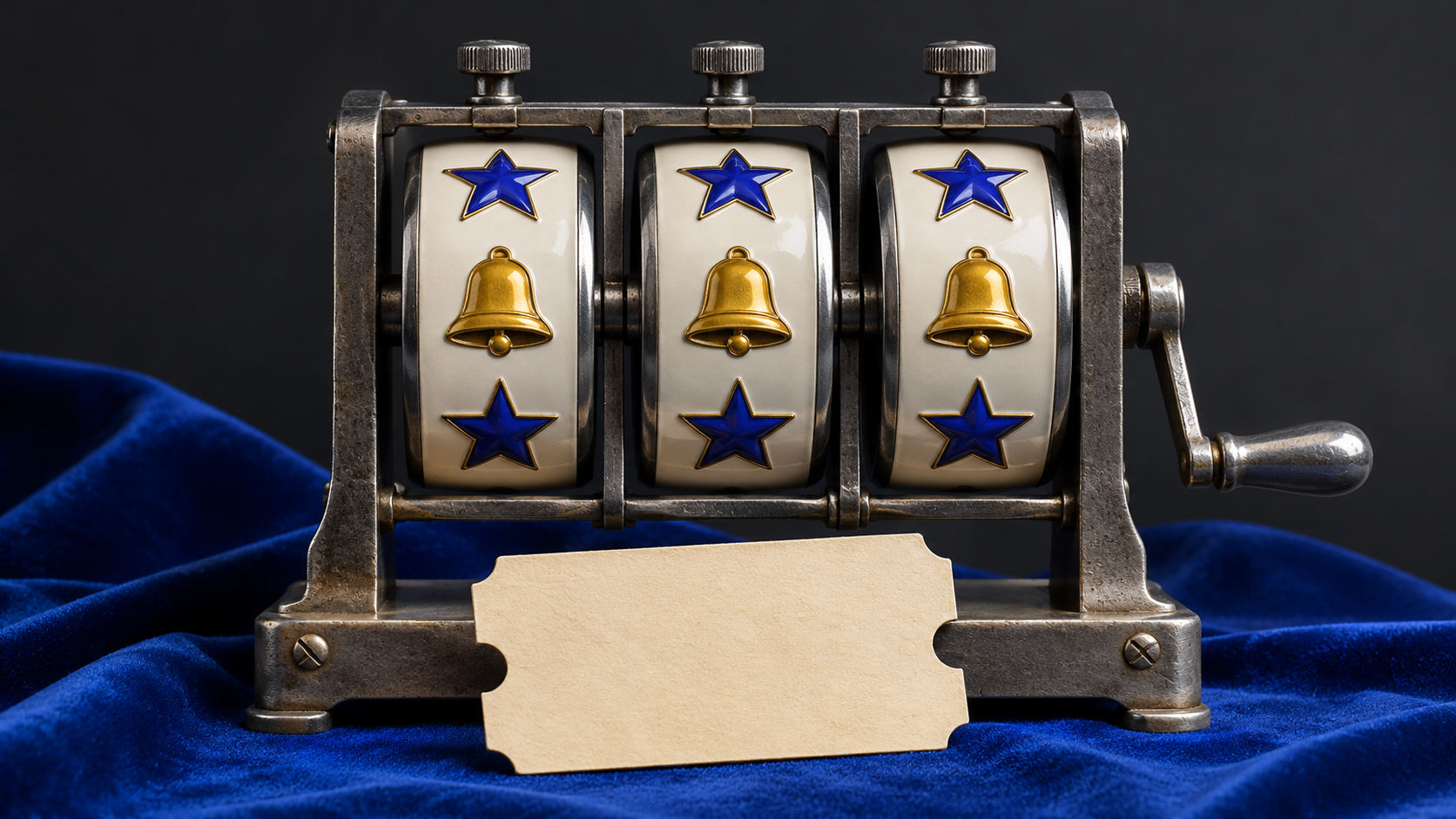
Image note: The cover is an AI-generated editorial illustration. Three mechanical reel drums stand behind a plain ticket on blue cloth.